
The balance: payment currency and refunds
A top-up, an order payment and a refund are separate account events. The published mechanics of the Kakobuy wallet, with every fee dated.
Inbound
Paying in, the four published channels
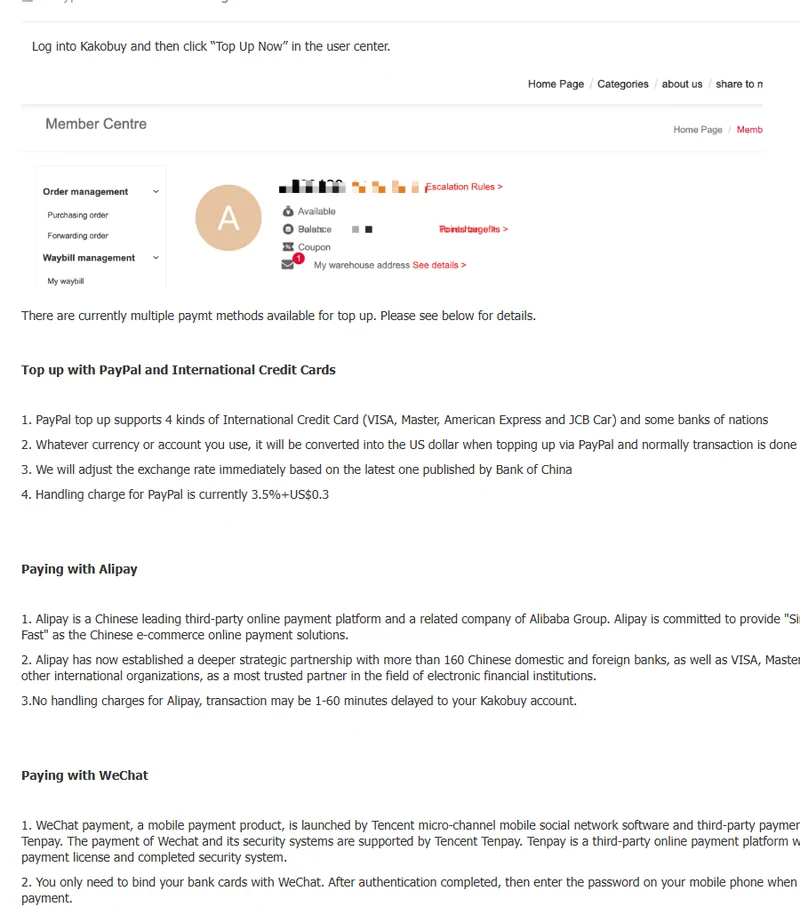
Top-ups happen in the member centre, denominated in yuan. The dated help article describes PayPal as an available channel: it accepts the big four card networks, lands almost instantly outside e-check cases, and describes PayPal payment in US dollars regardless of the payer’s starting currency. The October 10 official help pages conflict: articles 64 and 99 list 3.5% + US$0.30, while article 65 lists 2.9% + US$0.30. Confirm the actual checkout charge.
The dated article lists no handling charge and a 1-to-60-minute crediting range for Alipay and WeChat Pay. Confirm the requirements and availability of the option offered to your account; that range is not proof a particular payment succeeded. Bank transfer is listed too, and the help centre's own instructions still show the receiving account fields as the word “wait”, a placeholder that has outlived several site redesigns. Treat that channel as theoretical.
The same article does describe how a wire would behave if the fields were ever filled: an overseas remittance lands in a dollar account and converts to RMB at the platform's unified rate, domestic Chinese transfers credit within roughly a day, and a bank-route refund requires a valid Chinese account plus an original payment that itself came by offline transfer. For a buyer outside China, those clauses are reasons to confirm an available payment method and its actual refund requirements before transferring.
One more fossil worth knowing: the deposit-methods article refers to SUGARGOO in its opening line, a leftover from another agent's template. It is a reminder that help centres are copied and edited, and that dated screenshots beat remembered prose.
What the balance is, mechanically
The balance can settle the item payment and later freight. The dated article recommends balance payment, but actual conversion timing and processing charges need comparing against the methods offered in your checkout.
The help page’s USD wording describes PayPal payment; it does not establish how the wallet is held internally. Check the unit and amount in the credited account record. Changing the display currency alone is not evidence that funds have been converted or refunded. Cancelled orders refund to the balance first, which keeps money inside the system unless you actively pull it out.
| Field | Official value | Where the edge is |
|---|---|---|
| paypal fee | Official help snapshot: 3.5% or 2.9%, each + US$0.30; confirm checkout | Both percentages appear in official help articles. Confirm the charge in your actual checkout. |
| conversion | The dated article describes PayPal payment in US dollars | Compare payment currency, processor debit and account credit; the payment description does not establish the internal ledger currency. |
| fx comparison | Exchange-rate markup measured near 8.5%, October 2026 | A dated independent measurement, not an official rate or proof of the operator’s margin. |
| refund clock | Applications only after money has sat 2 days | Plus processing: card and ID verification for remitted money, 2-3 days of finance handling. |
At the counter
Paying at the counter
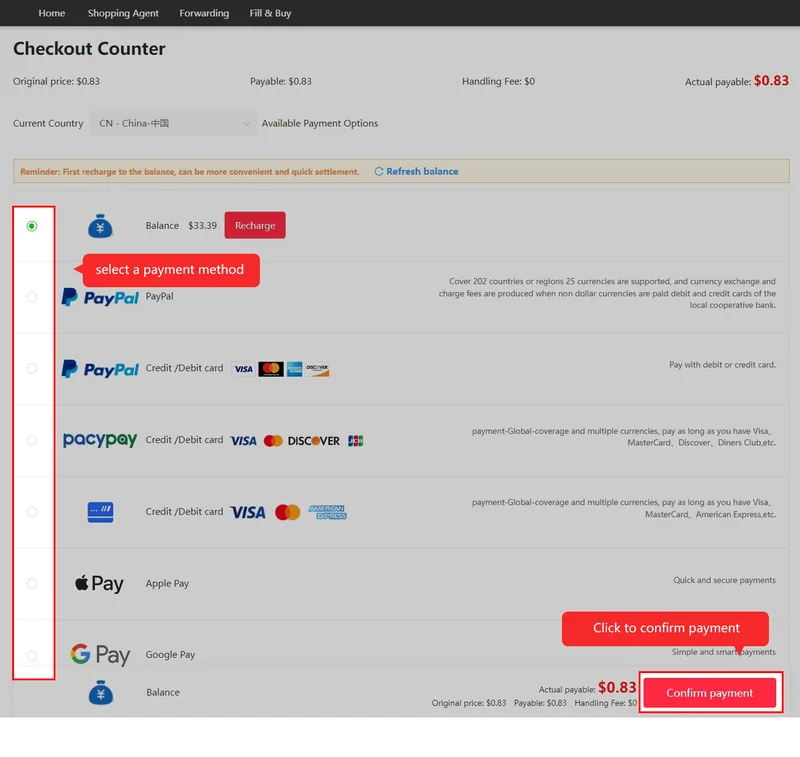
At checkout the counter lists balance first, then PayPal in both its wallet and card forms, then regional options. The tutorial's own counter screenshot shows a demo balance alongside PayPal's claim of covering two hundred countries; the practical reading is simpler. Balance and direct-payment flows can have different conversion timing and processor charges. Compare the actual amount debited and credited; paying from balance does not by itself prove a lower total cost.
Coupons apply at this screen too, from the shelf the inbox and points page describes. A freight coupon with a minimum spend reads the pre-discount freight figure, and the counter shows the arithmetic line by line before you commit.
Getting money back out
Refunds of top-ups return by the original payment route, with the handling fee on you. The application itself has a waiting period: the money must have been in the account more than 2 days before a refund can even be filed. Remitted money adds identity verification, card images and 2-3 days of finance processing.
Order cancellations behave differently from top-up refunds: they credit the balance, not your card. The distinction matters if you are winding an account down; check what amount is refundable, the deductions and the processing steps before choosing whether to spend or withdraw it.
Nothing in the published terms pays interest, honours a display currency, or promises a same-day exit. Fund the wallet like a transit account: enough for the order in front of you, nothing sentimental.
Your card was debited, but the order is still unpaid
First identify what the receipt records: a wallet top-up or payment for a particular order. If the wallet was credited, the order may still need its own payment action. If the debit has no matching account credit or paid order, keep the payment reference and displayed status, then ask official support to reconcile the transaction before paying again.
Record the currencies as well as the amounts. A processor debit, a converted payment and a displayed account balance can be different records of the same event; a changed display number alone does not establish a missing credit. The balance and top-up questions explain what to compare.