
What an order costs, layer by layer
A zero purchase service fee does not make an order free. Separate item price, domestic freight, payment handling, conversion and international shipping.
Published lines
The published fee structure
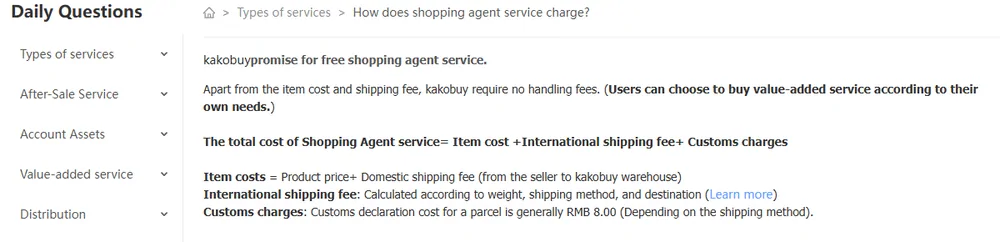
The operator's fee article is one sentence long where it counts: apart from item cost and shipping, the service requires no handling fees. The published total stacks item cost, the seller's domestic shipping, international freight, and customs charges, with declaration generally RMB 8.00 per parcel. Value-added services, photos, vacuum packing, priority purchasing, are opt-in lines on top.
The catalogue price is only one part of the total. Freight and payment costs depend on the goods, packed parcel and route; there is no fixed percentage that turns an item price into its delivered cost. Combining items can change both rate tiers and volume charges.
Exchange rates and the amount you actually pay
Every yuan you spend here was bought with your currency at the operator's posted rate, either when you topped up the balance or per order through PayPal. That posted rate is not the mid-market rate. An independent measurement in October 2026 put the gap near 8.5%, a historical comparison rather than a current rate for your account or payment method.
Compare the actual debit and yuan credit using a reference rate from the same time; the historical spread does not establish the operator’s margin. Official PayPal articles disagree between 3.5% and 2.9%, each plus US$0.30. Use the actual checkout charge and avoid depositing more than the order requires just to reduce a fixed fee.
The dated help page lists Alipay and WeChat Pay without a handling charge, with a crediting range rather than a guaranteed result. Check the requirements and actual options offered to your account before comparing them with PayPal. Note too that the top-up screen denominates in yuan, so the number you type and the number your wallet shows afterwards sit on opposite sides of the posted rate, which is the whole reason this section exists.
| Field | Official value | Where the edge is |
|---|---|---|
| cheapest line | $38.07, 11-17 days transit | Read on 10 October 2026 from the operator's estimator; quotes move without notice. |
| faster lines | Seven-to-thirteen-day lines quoted a dollar or two higher | Speed premiums at this weight were small on the day; route minimums were the bigger trap. |
| greyed lines | Headline-cheap lines refuse parcels under their minimums | Two US lines wanted 2 kg or more. A light parcel cannot buy the cheap headline. |
| volumetric | Length by width by height over a route divisor | Bulky-light parcels bill by volume. The divisor varies by route, so the same box prices differently per line. |
Tooling
Estimating before you commit
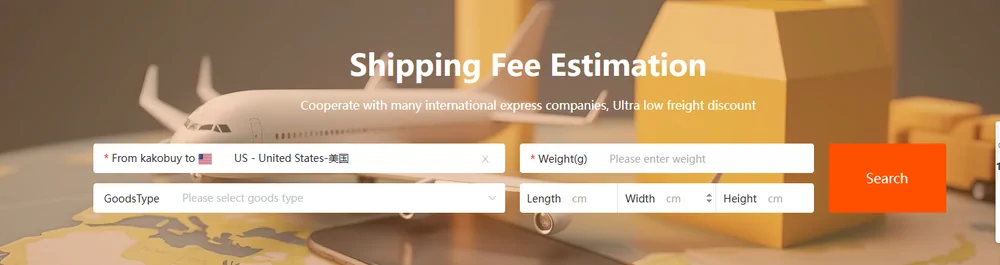
The freight estimator is public, no login needed: destination, weight, and optionally dimensions in, quoted lines out, each with transit time and route notes. Run it twice per parcel: once when planning, once after the warehouse weighs your actual consolidated box, because the billed figure follows the warehouse scale and the volumetric formula, not your guess.
Route notes deserve the reading time: minimum weights, battery and liquid exclusions, and destination-specific handling all live in those small lines. The walkthrough places this step inside the full flow.
Reading a coupon against the cost stack
Freight coupons from the shelf apply at parcel checkout and read pre-discount freight. A voucher with a high minimum may favour a larger eligible freight amount, but consolidation can also increase volumetric weight or remove a route option. Compare the final totals and restrictions; a larger discount does not prove the larger parcel costs less overall.
Use the sign-up pack only when a suitable shipment meets its terms; its vouchers carry dates, and the dated announcement framing it, ¥3000 in coupons published on 22 September 2024, is the figure to trust over the various banner numbers.